
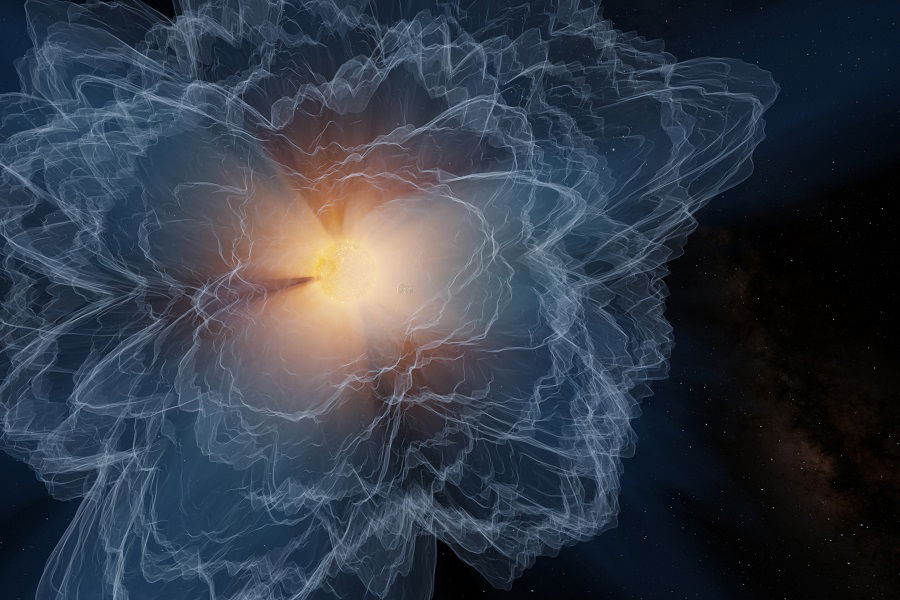
Astronomers have created the first continuous, two-dimensional maps of the outer edge of the Sun’s atmosphere, revealing a dynamic and changing boundary where solar material finally escapes into space. This boundary, known as the Alfvén surface, marks the point where the Sun’s powerful magnetic influence can no longer hold back the solar wind. Once particles cross this line, they are gone for good, streaming out to shape space throughout the solar system.
The new maps were produced by scientists at the Center for Astrophysics | Harvard & Smithsonian, who combined distant observations with close-up measurements from NASA’s Parker Solar Probe. Their work shows that the Sun’s atmospheric edge is far from smooth or fixed. Instead, it grows larger, rougher, and more spiky as the Sun becomes more active, and shrinks and smooths out when activity quiets down.
For years, scientists have known that this boundary shifts over the Sun’s roughly 11-year activity cycle, but until now they could only estimate its shape from afar. “To answer big questions about why the Sun’s outer atmosphere is so hot, we first need to know exactly where this boundary is,” said lead author Sam Badman. The new maps finally provide that missing clarity.
What makes this achievement especially important is that the maps were directly confirmed using data from Parker Solar Probe, which has repeatedly plunged deep into the Sun’s atmosphere. Using an instrument called SWEAP, developed by the CfA and the University of California, Berkeley, the probe measured particles and magnetic conditions below the Alfvén surface itself. This allowed scientists to test their maps against real, in-person data from one of the most extreme environments ever explored by a spacecraft.
The Alfvén surface acts like the Sun’s true outer edge. Inside it, magnetic waves can still travel faster than the solar wind, keeping material connected to the Sun. Outside it, the solar wind wins, carrying energy and particles across the solar system.
Understanding where this boundary lies helps scientists better predict space weather, including solar storms that can disrupt satellites, power grids, and communications on Earth.
The findings also reach beyond our own star. By learning how the Sun’s atmosphere behaves over time, researchers can improve models of other stars and better understand how stellar activity affects the habitability of planets orbiting them.
As the Sun continues its activity cycle, the research team plans to keep watching. Future dives by Parker Solar Probe, especially during the next quiet phase of the Sun, will help scientists see how this remarkable boundary changes over a full solar cycle, opening the door to deeper insights into how stars live and evolve.
https://knowridge.com/2025/12/scientists-draw-the-first-detailed-map-of-the-suns-point-of-no-return/
Be First to Comment