
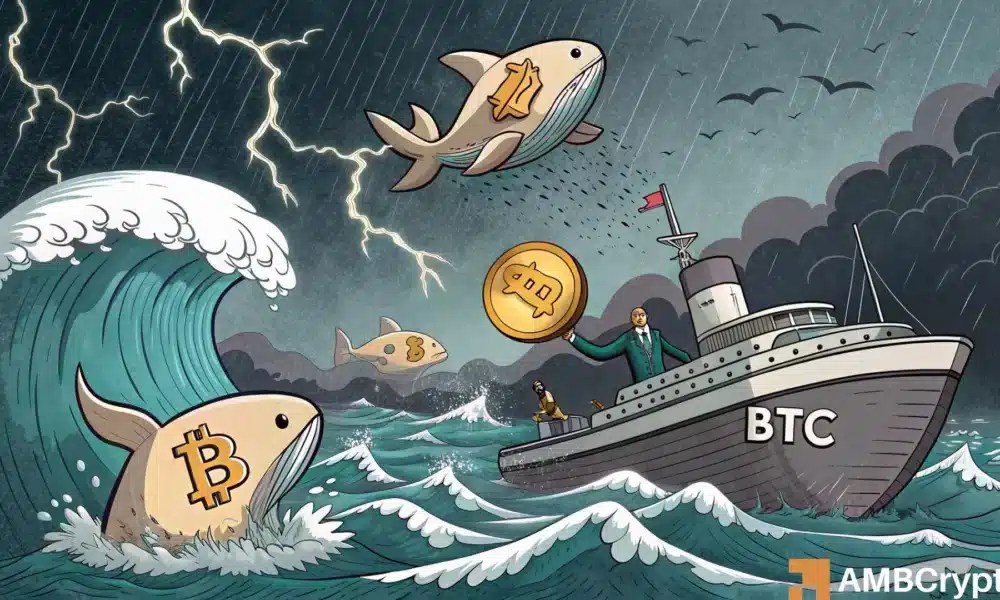
The post Bitcoin pays the price as OG whales take profits: More losses ahead? appeared com. Key Takeaways What is the main factor driving the recent sharp price decline in Bitcoin? Bitcoin OGs and Megawhales have been aggressively selling, offloading over $17,000 BTC and increasing supply for selling. What is Bitcoin’s short-term resistance and critical support level? BTC must breach the $111,513 resistance for a rebound or risk dropping below $106,124 support to $103,571. Since hitting $116k a week ago, Bitcoin [BTC] has faced massive downside pressure, dropping to a low of $106k. In fact, at press time, Bitcoin was trading at $107,758, down 2. 79% on the daily charts. Amid this market’s bearishness, long-term large holders have accelerated the downtrend by increasing the supply available for immediate selling. Bitcoin OGs are dumping As Bitcoin struggles, three OGs have sold 17, 265 BTC, considerably reducing their holdings. According to Lookonchain, Bitcoin OG (1011short) deposited 13K BTC, worth $1. 48 billion, to Kraken, Binance, Coinbase, and Hyperliquid. The second whale, Owen Gunden, has sold 3, 265 BTC worth $364. 5 million to Kraken. Darkfost also reported such whale activity Notably, insider whale 19D5 (Hyperunit seller) has sold 1000 BTC through Kraken. Surprisingly, these three whales are not an isolated case, as Megawhales have been selling aggressively. According to Checkonchain, on the 2nd of November, Megawhale Balance Change surged to 32. 6k BTC, then dropped to 23. 4k on the 3rd of November. Typically, when Megawhales turn to aggressive selling, it reflects a lack of market conviction, as they anticipate further downside. Even so, increased exchange deposits from this cohort raise the supply available for immediate selling, thus accelerating further downside.
Tag: key
3 Reasons to Choose a Medicare Advantage Plan During Open Enrollment

The post Charles Hoskinson Reacts to Scott Bessent’s Bitcocom. Key Notes US Treasury Secretary Scott Bessent posted on X about Bitcoin’s reliability over the last 17 years. Charles Hoskinson is somewhat surprised that he made the post as an elected official. Bitcoin has seen more mainstream and institutional adoption this year. Cardano founder Charles Hoskinson finds it amusing that the United States Treasury Secretary is advocating for Bitcoin (BTC). He suggested this stance in an X post from November 1 after Scott Bessent made a post acknowledging the publication of the Bitcoin Whitepaper 17 years ago. US Pro-crypto Administration is Vocal About Bitcoin On October 31, the Bitcoin community was reminded that it had been exactly 17 years since Satoshi Nakamoto published the Bitcoin Whitepaper. US Treasury Secretary Scott Bessent also posted on X regarding the anniversary, highlighting the reliability of the flagship cryptocurrency over the years. “17 years after the white paper, the Bitcoin network is still operational and more resilient than ever. Bitcoin never shuts down,” the US executive explained, while calling on the Senate Democrats to learn something from that. Hoskinson immediately reacted to this post, stating that it is “profoundly magical” to see the US Treasury secretary making a post about Bitcoin and its reliability. It signals a notable shift from the anti-BTC stance in the region previously. The pro-crypto administration of President Donald Trump should be recognized for this change. Something is profoundly magical about the sitting Treasury secretary of the United States tweeting about Bitcoin and its reliability Charles Hoskinson (@IOHK_Charles) November 1, 2025 Moreover, the statement reflects the mainstream acceptance and adoption of the firstborn digital asset. Over the last few months, several institutions and countries have added Bitcoin to their strategic reserves. France Plans to Launch Bitcoin Strategic Reserve Just before October came to an end, France saw a.

The post Plasma drops 15% But ONE metric fuels hopes of XPL rebound appeared com. Key Takeaways Why did Plasma defy typical bearish trends? Open Interest surged to $255 million despite a 15% price drop, showing renewed trader participation. What could drive XPL rebound soon? A steady Long/Short Ratio above 2. 0 and ongoing short liquidations may strengthen bullish momentum. Plasma [XPL] dropped nearly 15% in the past 24 hours, extending its October slide. Yet, on-chain data revealed unusual behavior among derivatives traders that could hint at an early-stage rebound if bulls sustain their momentum. Open Interest surges despite the explosive bearish drop Despite the steep decline, Plasma’s Open Interest (OI) rose to $255. 08 million, up from lows of around $233 million. Typically, OI contracts when prices fall as traders exit positions. The rise this time indicated new positions were being opened, possibly by institutional traders buying the dip. Short liquidation sends mixed signals Meanwhile, Plasma’s Aggregated Short Liquidations climbed to $1. 33 million at press time versus just $49,000 in longs. The imbalance reflected growing short pressure being squeezed as volatility rose. That setup could swing either way: a deeper correction if momentum fades, or a rapid bounce if short sellers retreat. 027, meaning longs outnumbered shorts roughly two to one. Such dominance often signals increasing trader conviction in a price recovery. Even so, whether the optimism holds will depend on sustained demand in both Spot and Futures markets. The combination of short liquidations and higher long exposure gives bulls a near-term edge, but only continued accumulation can confirm a shift in trend.
The post Circle debuts public testnet of its payment-focused Arc chain Details appeared com. Key Takeaways What’s next for Arc as it rolls out public testnet? If the test is successful, the payment-focused chain could soon hit the public mainnet for everyone. Why is Arc’s progress important? It signals incoming shifts across the stablecoin payment ecosystem, and whether Ethereum will hold its ground remains to be seen. Circle, the issuer of the USDC stablecoin, is close to launching its Arc chain A global payment-focused L1 powered by digital dollars. In a statement on 28 October, the firm said that it had begun public testing for the chain alongside key design partners. The partners include top banks, insurers, and asset managers like BlackRock, HSBC, and Absa, among others. According to Circle CEO Jeremy Allaire, the partners have billions of users and handle trillions of dollars in assets across the globe. He claimed that Arc can seamlessly allow local markets and builders to connect to the global economy. Allaire called it the “economic OS of the internet,” and added, “This geographic diversity highlights a defining strength of Arc: its purpose-built to connect every local market to the global economy. In fact, BlackRock’s Global Head of Digital Assets, Robert Mitchnick, underscored FX and tokenization as key interests for them in the project. He said, “Exploring Arc will provide insight into how stablecoin-denominated settlement and onchain FX capabilities might enable more efficient capital markets and unlock additional utility for onchain assets. Google, Stripe, and Tether have similar plans. In fact, Tether-backed Plasma [XPL] is already live and handles about $6 billion of the stablecoin supply. It’s.
Truth Predict’s launch could reshape social media engagement, blending financial speculation with real-time event discussions and analysis. The post Trump Media unveils Truth Predict for real-time event trading on Truth Social appeared first on Crypto Briefing.