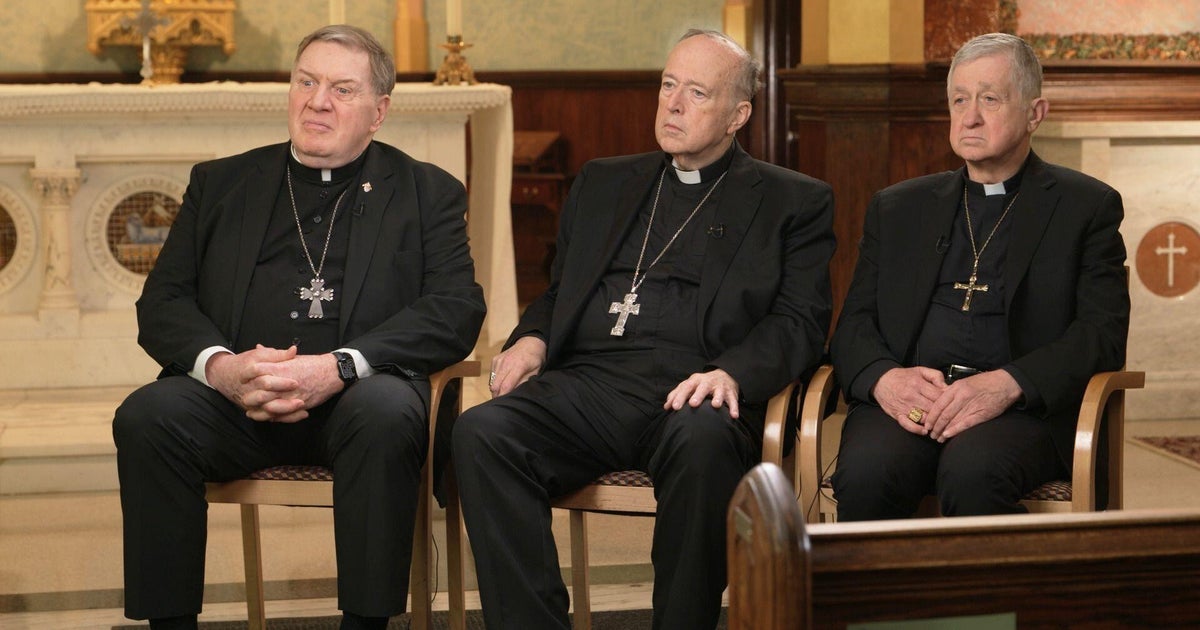
When President Donald Trump announced a ceasefire with Iran this past week, it came after a chorus of world leaders called for an end to the war. One of those voices belonged to Leo XIV, the first-ever U. S.-born pope in the history of the Catholic Church. The 70-year-old pope was born Robert Prevost and grew up in Chicago. For many years he was known simply as Father Bob. Leo is measured, deliberate and soft-spoken. But the American pope has become increasingly outspoken against certain policies of the American president. So we asked three influential American cardinals who know him well, why Pope Leo’s church has emerged as a voice of moral opposition to the war in Iran and the crackdown on immigration. “Peace be with you:” those were the first words that Pope Leo uttered as the new leader of 1. 4 billion Catholics worldwide. His selection was a surprise, celebrated by many of the 53 million that make Catholicism the largest Christian denomination in the United States. Norah O’Donnell: What do you think having an American pope has done for the Catholic Church here in the U. S.? Cardinal Joseph Tobin: I think it’s put Chicago on the map. Cardinal Blase Cupich: Finally. We’re proud we’re proud that we produced a pope. Chicago can say that. The archbishop of Chicago, Cardinal Blase Cupich, as well as Cardinals Robert McElroy of Washington D. C., and Joseph Tobin of Newark, New Jersey, agreed to their first ever joint interview. Their candor surprised us, about the new pope and what they’re hearing in the pews. Cardinal Joseph Tobin: We’re the three American cardinals that are actively serving dioceses right now. So we listen to a lot of people. It’s part of the job description. And I think we’re aware of the anxieties of people about the threats to peace at all different levels. Norah O’Donnell: Would you like to see this first American pope be more outspoken on issues that he disagrees with? Cardinal Joseph Tobin: He’s the pastor of the world. He’s not a pundit. So the distinction is he’s not going to pronounce on everything. But he’s going to pronounce on what’s important. He started in January with a speech criticizing U. S. military action in Venezuela. After that, the Vatican’s ambassador in the U. S. was called to the Pentagon for a meeting, which two church officials described to 60 Minutes as unpleasant and contentious. Both the Pentagon and the Vatican have said since in multiple statements that it was routine and provided an opportunity for an exchange of ideas. In March, we traveled to Italy and managed to ask Pope Leo a question about the war in Iran. Norah O’Donnell: Holy Father, can I ask you what your hopes are for the Middle East? Pope Leo XIV: I am praying for peace, I hope that ceasefire would be the most effective way to work together to find peace for all parties, to respect all parties and to come to a solution, which is too many years, and you know, creating problems for everyone, so . Work for peace. Since our visit, the pope’s tone has sharpened; this past week he issued a rare condemnation of President Trump’s threat to destroy Iranian civilization. The pope called it, quote “truly unacceptable.” He also took the unusual step of issuing a call to action. Pope Leo XIV: “Contact the authorities political leaders, congressmen to ask them, tell them to work for peace and to reject war always.” The holy father usually avoids calling out President Trump by name or any member of his administration. But in a Palm Sunday homily, he appeared to reference the religious language Defense Secretary Pete Hegseth, who is Christian but not Catholic, often uses to frame the war. Pope Leo warned that Jesus, quote “does not listen to the prayers of those who wage war.” Norah O’Donnell: Is this a just war? Cardinal Robert McElroy: No, in the Catholic teaching this is not a just war. The Catholic faith teaches us there are certain prerequisites for a just war. You can’t go for a variety of different aims. You have to have a focused aim, which is to restore justice and restore peace. That’s it. Norah O’Donnell: Iran has been the chief exporter of terror. Is there no scenario in which preventing that can be a just war? Cardinal Robert McElroy: It’s an abominable regime, and it should be removed. But this is a war of choice that we went to, and I think it’s embedded in a wider moment in the United States that’s worrying, which is this: We’re seeing before us the possibility of war after war after war. President Trump has argued that military action against Iran was justified in order to destroy its nuclear and ballistic missile programs, among other reasons. Cardinal Cupich not only takes issue with the war, but also what he calls “the gamification” of how the White House has portrayed it on social media. Cardinal Blase Cupich: We’re dehumanizing the victims of war by turning the suffering of people and the killing of children and our own soldiers into entertainment. Norah O’Donnell: You called it sickening. Cardinal Blase Cupich: It is sickening to splice together movie cuts with actual bombing and targeting of people for the t– purposes of entertainment is sickening. This is not who we are. We’re better than this. We spoke with the cardinals in the nation’s capital. It was a wide-ranging conversation, in which they told us Pope Leo inspired them to weigh in on political issues, including the administration’s mass deportation efforts. This past January, Cardinal Tobin called Immigration and Customs Enforcement or ICE a “lawless organization.” Norah O’Donnell: Cardinal, those are strong words to call ICE “a lawless organization.” Cardinal Joseph Tobin: Yeah. Norah O’Donnell: Why did you do that? Cardinal Joseph Tobin: I didn’t say that they were people without law. But when people act in this way, when they have to hide their identities to terrify people, when they can actually violate other guarantees of our Constitution and Bill of Rights, well I think somebody’s got to call that out and I’m not the only one. Norah O’Donnell: Cardinal McElroy we are s– speaking in a church here in Washington, D. C. that serves a largely immigrant population. The pastor asked us not to share or publicize this parish name or location. What’s he worried about? Cardinal Robert McElroy: He’s worried for his people. They live under fear, and thus our mass count within the Spanish masses in our archdiocese went down 30% from the year before. 30%. That’s a lot. And it’s all fear. Before he became archbishop of Washington, Cardinal Robert McElroy served as the bishop of San Diego, one of the busiest stretches of the southern border for illegal crossings. Cardinal Robert McElroy: I feel it got to a point where it was getting out of control. Norah O’Donnell: Under Biden? Cardinal Robert McElroy: Under Biden, yes. Norah O’Donnell: You believe in strong borders. Cardinal Robert McElroy: Yes. Norah O’Donnell: So what’s wrong, then, with the current policy? Cardinal Robert McElroy: This is a roundup of people throughout the country. People who have been living good, strong lives, been here a long time, raised their children here, many of their children born here, and are citizens. That’s what our objection is Norah O’Donnell: But this was discussed during the campaign. It was widely discussed. And yet President Trump won the Catholic vote over Kamala Harris handily, 55 to 43%. He promised to secure the border. He talked about deportation. And a majority of Catholics voted for the policy. Cardinal Blase Cupich: I would like to know what Catholics feel about this indiscriminate mass deportation. I– I think that it’s very clear the American people are saying, “We really didn’t vote for this.” Norah O’Donnell: What do you say to people in the pews who say, “I don’t want to hear politics from my priest”? Cardinal Blase Cupich: I say fine. I want to preach the gospel. God wants us to promote peace in the world– because his desire is that we be one human family. Cardinal Robert McElroy: What we’re seeing as pastors is an enormous, profound level of human suffering And that’s what motivates us. We found a sign of what motivates Leo and how his church will care for migrants and the less fortunate in a sacred space 15 miles southeast of Rome. Nearly 2, 000 years ago, Castel Gandolfo was the villa of a Roman emperor. For the last 400 years it has been the pope’s summer home. Leo’s predecessor, Pope Francis, enlisted Father Manny Dorantes, a priest from Chicago, and an immigrant to the U. S. himself, to help open it up to the world. Father Manny Dorantes: I think Pope Leo wants to make the dream of Pope Francis a reality. After we explained the whole vision and talked with him– he said to us, “Full force ahead, Father Manny.” That vision is an innovative new project centered around migrants and locals in need participating in the Vatican’s first job training center. They’re teaching sustainable farming, gardening and cooking at the same estate where Pope Leo comes to rest every week. Norah O’Donnell: How many migrants are you talking about that may be part of this job training program? Father Manny Dorantes: Between migrants and people in vulnerability, our goal is to be able to s– at least train about 1, 000 people, you know, per year. That doesn’t sound like a big number. But ultimately, it’s a model of how if every church did something like this, every diocese– we have 6, 000 of ’em, you know– that’s a lotta people we could train in a year. We met the first graduating class of chefs in training that included refugees and migrants from around the world. One was a young man from West Africa, who survived the dangerous journey by sea to the Italian island of Lampedusa in the Mediterranean, where tens of thousands of migrants have drowned. Norah O’Donnell: Pope Leo will spend July 4th in Lampedusa, Italy, a site where tens of thousands of migrants land on their way to Europe every year. It’s America’s 250th birthday. Do you think the Holy Father is sending a message, Cardinal, with that visit? Cardinal Blase Cupich: He’s sending a message that– his top priority right now is to be with those who are downcast and marginalized. Norah O’Donnell: Coincidence that he’s going there on July 4th? Cardinal Joseph Tobin: I know at least one member of my– archdiocese that will be happy and she’s green, and she’s on a little island just- that belongs to New Jersey and is technically part of the Archdiocese of Newark. And she’s holding up a torch, and she’s reading from a scroll, and it says, “Welcome.” So far in 2026, the Catholic Church in the U. S. has welcomed the largest number of converts in recent years. In Cardinal Tobin’s archdiocese, there’s an all-time-high of new people joining the church. Norah O’Donnell: Cardinal Tobin, do you think that surge in interest and attendance has something to do with Pope Leo? Cardinal Joseph Tobin: Yes, I– I do. I’ve had the privilege of working closely with four popes, very different people in a lot of ways. But each one in some way was the right one for that moment in time. I– I believe that– Pope Leo is the right man at this time. Produced by Keith Sharman, Julie Morse Goff, Roxanne Feitel. Field producer, Anna Matranga. Broadcast associates, Grace Conley, Callie Teitelbaum. News associate, Julia C. Doyle. Edited by Peter M. Berman.
https://www.cbsnews.com/news/pope-leo-iran-war-mass-deportation-statements-inspire-american-cardinals-60-minutes-transcript/
Salsanis Analytics